The kids aren't alright
Or, the case for social history

In January I made my triumphant return to the History program at Concordia. (As I write this, I’m procrastinating on a 3000-word paper—because after all, that’s what school is really all about.) This came after a wild three-year ride which involved unceremoniously dropping out mid-session at the beginning of winter 2023, ghosting my Honours thesis supervisor, doing a 15-month cabinetmaking program, struggling to find work in the field, getting a job at a pizza parlor, and becoming very depressed.
And honestly, I’m so glad to be back. If there’s anything that will make you appreciate school, it’s an extended period of crushingly unsuccessful job-hunting in the real world.
When I first started university, it was way, way back in the mists of 2018 (a pre-pandemic world!) and I was 20 years old (not counting the single class of an Intro to Film Studies course I attended and promptly dropped the September after graduating high school). So yes, for those counting, I am now a 28-year-old undergraduate student. New opportunities for humility abound every day.
At the beginning of my university journey I was attending the University of Winnipeg and dating a Maoist, so I joined the university’s chapter of the Revolutionary Student Movement, itself a front organization for the local cell of the PCR-RCP—the Revolutionary Communist Party of Canada (*insert gravestone emoji*). I was only a member for about a year, but I went in head-first: tabling, organizing rallies and conferences, hosting reading groups. And the meetings—many, many meetings, and long ones too. So, basically, everything you’d expect from a group of 20-year-old communists.
I say all this, both to put my cards on the table somewhat (while I wouldn’t necessarily call myself a Maoist these days, I am constantly being made aware of the myriad ways that, for better or for worse, a lot of my most foundational beliefs were formed during that period of my life), and also to give a sense of what the political climate was like when I first started university. Sure, the organization’s membership was tiny (a cast of maybe 10-ish regulars, supplemented by non-student RCP members of the same age group), but there were chapters at both major universities. And the RSM chapter at the U of Manitoba was even more active than ours, doing ‘high-risk’ actions like occupying the president’s office, that kind of thing. And whatever feelings you might have about this kind of student organization (most likely I share many of them myself) you cannot deny that it brought a certain je ne sais quoi to the academic political arena, at least stretching the Overton Window a little further left than it might have been otherwise.
Because I’ve been in university on and off for almost a decade now, I’ve been privy to changes in the political tenor of the institution that might not be observable within the usual three-to-four-year turnaround time of a typical undergraduate degree. And look, okay, this isn’t a scientific study, and some of these supposed ‘changes’ might just be things I’ve become more aware of with time. Or maybe I’m just an ex-Maoist with a chip on my shoulder. Who knows. But the phenomenon that I’ve noticed that most concerns me is the strange, sneaky manner in which the humanities seem to be increasingly stripped of their political content, despite the fact that it feels like ~now more than ever~, we need art, history and philosophy that acknowledges and addresses (even just tries to address!) the rising tide of fascism, jingoistic warmongering, and widening gulfs of inequality in our current world.
History as an academic discipline is inextricably beholden to Marx—not every historian has been a Marxist, but they’ve all had to grapple with the pull of the materialist framework for understanding historical change over time (wherein, crudely, social change is driven by changes to the mode of production and, therefore, to a society’s economic system). Critics have called this theory economically reductionist, Eurocentric, etc., but the fact that Marx has been taken up widely by Third World and feminist scholars demonstrates that there is clearly something there—some liberatory potential. I’m summarizing 150 years of scholarly debate in a vulgar fashion here, but my point is, whether you like it or not, the academic study of history as we know it today was built on these very debates.
In the 60s and 70s, especially, a period in which waves of decolonial movements swept the globe and profound disruptions to the racial and gendered order in the industrial core occurred, what’s known as ‘social history’ came to prominence within the academy. Pushing back against the tendency of history to privilege the stories of those about whom there is the greatest mass of written documents (i.e. the elite classes of society), social historians read ‘against the grain’ of the archives to find information about those who have generally been left to the historical margins: women, Black, Indigenous, and people of colour, the poor and working-class, etc.
What has felt most noticeable to me upon my return to academia this time around, is how the tides of opinion have turned against this movement in historical writing and its contemporary proponents (particularly those who call for an adherence to disciplinary principles of truth-seeking), tending to view them now as naive, cringe, or even somehow conservative. The core tenets of historical materialism have largely been maintained but are never discussed in directly Marxist terms—kept in a tank for posterity, but defanged.
Instead, the theorists most commonly referenced are Foucault and Derrida. Everywhere you hear about the ‘archival turn’; relentlessly we are steered toward conclusions based on the instability of knowledge, the uncertainty of fact. And while there is a value to this kind of skepticism when dealing with manuscripts which are, necessarily, produced by historical actors with their own ends, there must be a limit—a line in the sand by which you establish and defend your own beliefs. Otherwise, frankly, why believe anything? Social history was birthed out of the same movements that gave us civil rights, universal healthcare, unions… When was the last time a Foucauldian has done anything for you?
I joke, but particularly with the disturbing revelations of the most recent release of Epstein files—specifically those related to the academic left’s golden boy, Chomsky—it just seems like we’re long overdue for a reassessment of the kind of empire-friendly soft-radicalism that his ilk have wrought upon us.
And it’s not just for my own petty, hair-splitting benefit that I say all this. It’s because the conditions of education have so clearly changed: from conversations with classmates, I’ve noticed that more students than ever seem to be working 30+ hours a week while still maintaining a full course-load; people seem less willing to go into debt, fearing (particularly us unfortunate souls in the humanities) that their meagre employment prospects will mean being locked into a form of indentured servitude for life. As one classmate said to me before a seminar, “In my whole four-year degree, I’ve never worked so much or been so poor.” They added that they worry their 3.8 GPA, lower than it could have been if they hadn’t had to work full-time for the past year, will hold them back from funding and internship opportunities available to their wealthier peers who can afford to devote all their time to schoolwork. And the cycle continues.
These are anecdotal observations, so feel free to take them with a grain of salt. But what I’m seeing seems like nothing short of crisis: a crisis of the economy, a crisis of public education, and, above all, a crisis of hope.
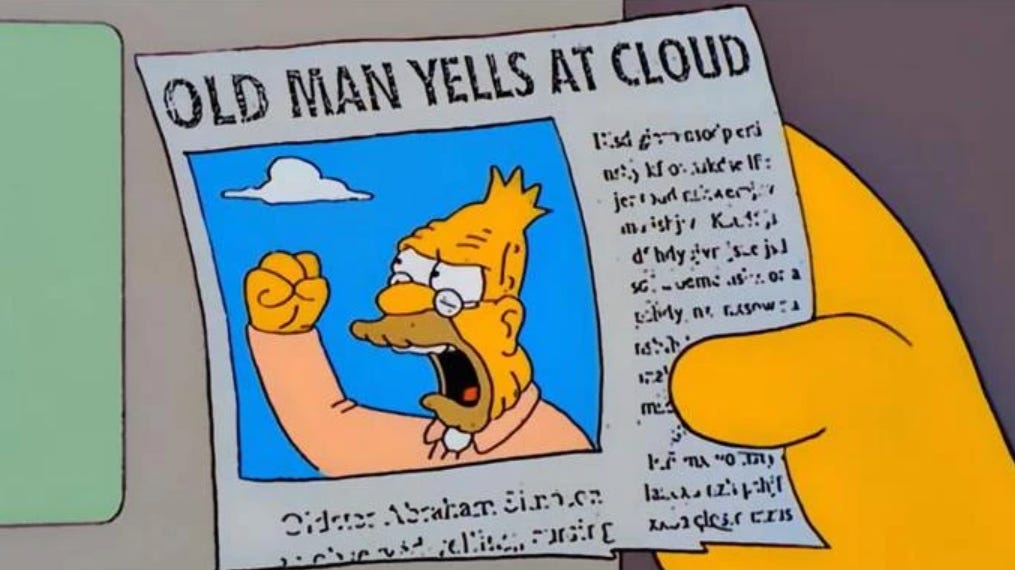
Pretty much everyone in my classes is under 25—a fact I learned when a prof asked our 16-person seminar who remembered 9/11, and everyone except me and one other guy shook their heads. “I wasn’t even a thought,” someone said. A joke from the same professor referencing Nirvana’s “Pennyroyal Tea” went over in much the same way. I know, I know, *Simpson’s Old Man Yells at Cloud meme*. But honestly—I returned to school at the age of 28 expecting to be irritated by my younger classmates. Instead, I’ve found myself humbled by their studiousness, their keenness, and their work ethic. The more I get to know them, the sadder I feel: the world they will be graduating into is already unrecognizable from what it was when I started university almost a decade ago, and if I hadn’t gotten the bulk of my degree out of the way during a period when things were (relatively speaking, of course) economically conducive to it, I truly don’t think I would have gotten as far as I have. I simply don’t have their tenacity.
I think I’ve (finally) learned in my eighth year of school that it’s a mistake to look to academia to be the intellectual vanguard of the left. And in some ways, that’s fine—more so than before, I have a great respect for the craft of history, for the value of learning something on its own terms and not purely for its political utility. But what’s at risk when education becomes divorced from politics is a deepening divide of resentment between students and the faculty who came into their positions in a generation when things were markedly different, when a university degree was still prized by employers and a full-time course-load wasn’t something you juggled alongside a 25-hour-a-week kitchen job. And if the discipline of history no longer seems to offer people a way out, why bother studying it at all?